
The 44th annual meeting of the Astronomical Society of India (ASI) was inaugurated at IIT Guwahati, bringing together astronomers, researchers, and students to discuss the future of astronomy in India.

Interim All India Tennis Association (AITA) President Chintan Parikh has accused court-appointed administrator Justice (Retd.) Gita Mittal of financial exploitation and procedural bias, alleging that her actions are draining the sports body's finances and compromising its autonomy.
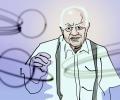
Jayant Narlikar wrote alternative what-if histories, explained difficult scientific theories with funny analogies, and leavened his lectures with jokes and humorous asides.
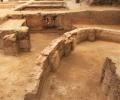
'Archaeological sites like Keeladi, having remained buried for 2,500 years, have come out and speak now.'

There are tweaks in references to B R Ambedkar's experience about the discrimination.

Industry leaders on Thursday mourned the death of Ratan Tata saying with his demise India has lost a visionary who shaped its industrial and philanthropic landscape. Tata was a truly remarkable business leader who placed the country before business interests, and whose vision was truly transformational for a country and its people, TVS Motor Co Chairman Emeritus Venu Srinivasan said in a statement. "Mr Tata was a truly remarkable business leader, the likes of whom nations get only once in a century," he added.

These inspiring stories of women shattering the glass ceiling will make you believe in a brighter, gender positive future for India.

'A person weighing 68 kilograms on the Earth would weigh only over 11 kg on the Moon'
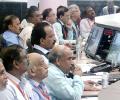
Leading scientists and experts said this monumental accomplishment not only marks India's indelible imprint on lunar exploration but also demonstrates the prowess of human collaboration, determination, and cutting-edge technology.
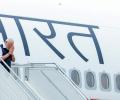
'Bharat is a name that is 7000 years old.' 'We are not saying the name of the country should be changed from India to Bharat; we only recommended that the stress should be on Bharat.'

Born in 1929, Swarup was one of the pioneers of radio astronomy in India.
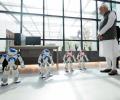
'We are calling companies to set up assembly plants for mobile phones while all the components are imported.' 'Only the last turn of the screwdriver is done here. And you call it self-reliance, Atmanirbharta, etc.' 'Unless you invest in research, you will not climb up the ladder. But this government is happy getting sub-contract work.'

At this year's TIME ball in New York City on Thursday, April 25, you would have run into a Coimbatore-born American scientist, looking lovely in Sabyasachi Mukherjee designer finery, who would most likely have been hanging out with Dua Lipa.

On Thursday, the earth will be at the nearest point to the sun. It will be at Perihelion at a point 0.983 Astronomical Units from the sun.

'It looked as if India had been a major player in science at that time, raising the question when and why things changed,' says distinguished aerospace scientist Professor Roddam Narasimha.
'There is enough proof of science-driven research in the India of early centuries,' argues Kumar Abhishek.

... Are far-reaching social changes coming with it, asks Ajit Balakrishnan.

The government has chosen to profiteer off people's misery and suffering, Gandhi said.

The two leaders had some firm convictions in defence matters and are idolised by their respective people because they salved the scarred collective psyches of their societies.

An interplay of Modi government's outreach in Bihar and the sequence of events in Chirag Paswan's life could make Bihar a game of musical chairs when the results are out.

'The government has said it has kept its powder dry to fight the true battle against the debilitating influence of the pandemic.' 'The release of the shocking economic data this week should act as the fuse for using that powder now.' 'Further delays will make the battle that much harder,' notes Shreekant Sambrani.

When I met him last year for his 75th birthday, he seemed frail. There was a sense of urgency. I will miss Stephen. His passing fills me with sadness.

Despite the government crackdown on Web sites advertising escort services, the Internet leaves enough wiggle room for debauchery to thrive.

'It is good for the country, but it is not good for a politician... What we call impatience is actually desperation to needing something NOW.' 'Our politics is restricted by one factor; that our Parliament is full of villages. 40% of the country now lives in cities but only 25% of Parliament is coming from the cities.'
